


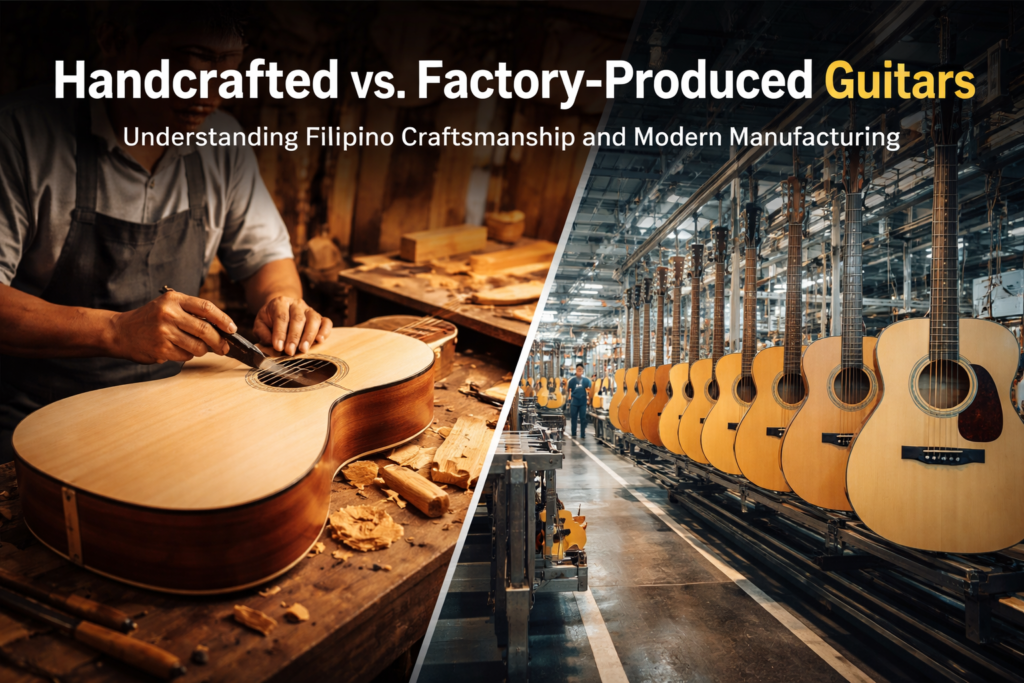
In today’s guitar market, musicians are often faced with two very different types of instruments: handcrafted guitars and factory-produced guitars. At first glance, they may look similar, but the way they are built—and how they feel and sound—can differ significantly. Understanding these differences helps musicians make more informed choices and better appreciate the craft behind their instrument.
How Filipino Luthiers Traditionally Build Guitars
In the Philippines, guitar-making is deeply rooted in tradition, especially in well-known luthiery towns such as Guagua, Pampanga. Filipino luthiers often learn their craft through apprenticeship, observing and practicing techniques that have been passed down for generations.
Unlike factory production, traditional luthiery relies heavily on hands-on methods, including:
Hand-shaping: Each neck, body, and brace is carved and refined by hand rather than cut entirely by automated machines. This allows the luthier to respond to the natural characteristics of the wood.
Voicing: Luthiers carefully shape the soundboard and internal bracing to influence how the guitar vibrates and resonates. This step is crucial in determining the instrument’s tonal personality.
Tap-tuning: By gently tapping the wood and listening to its response, the luthier adjusts thickness and bracing until the desired tonal balance is achieved. This is a skill developed through experience and a trained ear.
These processes are guided not by rigid templates, but by the wood itself and the luthier’s judgment.
Handcrafted vs. Factory-Produced: Key Differences
1. Tone Consistency
Factory-Produced Guitars: Designed for consistency, factory guitars are built to sound as similar as possible from one unit to the next. Computer Numerical Control (CNC) machines and standardized measurements ensure uniform output, which can be an advantage for large-scale production.
Handcrafted Guitars: While handcrafted guitars may vary slightly from one instrument to another, each guitar develops its own unique voice. Rather than identical tone, the focus is on musical character and responsiveness.
2. Wood Selection
Factory-Produced Guitars: Wood is selected based on grading systems and availability in large quantities. Pieces are often chosen to meet uniform specifications rather than individual tonal potential.
Handcrafted Guitars: Luthiers personally inspect and select wood, considering grain pattern, stiffness, weight, and resonance. Even small differences in wood are accounted for during the build process.
3. Build Character
Factory-Produced Guitars: Precision and symmetry are priorities. Finishes are often thicker and highly polished to protect the instrument during shipping and storage.
Handcrafted Guitars: Build character reflects the human touch. Neck shapes, body contours, and finishes may feel more organic, enhancing comfort and playability.
4. Wood Drying and Seasoning
Factory-Produced Guitars:
Factory manufacturers typically dry wood using modern technology such as kiln-drying and controlled humidity systems. This process allows wood to reach a stable moisture content quickly and consistently, which is essential for large-scale production and uniform results.
Handcrafted Guitars:
Traditionally, handcrafted guitars—especially those made by Filipino luthiers—use sun-dried or air-dried wood, allowing the wood to season naturally over long periods of time. This slow drying process helps relieve internal stress in the wood and is often associated with improved resonance and tonal maturity.
However, many modern handcrafted workshops also use controlled drying methods, particularly during the rainy season or in high-humidity conditions. These technologies help protect the wood from warping, cracking, or mold while still allowing the luthier to carefully monitor and adjust the material before construction.
Rather than relying on speed alone, handcrafted builders choose drying methods based on climate, wood type, and build requirements—balancing tradition with practicality.
Understanding “Imperfections” in Handcrafted Guitars
One common misconception is that handcrafted guitars should look flawless. In reality, small visual irregularities are often signs of genuine handwork rather than defects.
Examples may include:
Slight variations in binding or purfling lines
Minor asymmetry in wood grain or carving
Natural marks or color variation in solid wood
These details do not negatively affect sound or durability. Instead, they highlight that the instrument was shaped by human hands—not mass-produced by machines. Many musicians find that these subtle differences add personality and authenticity to the guitar.
What Craftsmanship Feels and Sounds Like
A handcrafted guitar is often described as:
More responsive to light and dynamic playing
Alive in the hands, with vibrations felt through the body and neck
Expressive, reacting differently depending on touch and technique
Rather than chasing perfection on paper, traditional luthiery focuses on how the guitar performs musically. The result is an instrument that feels personal, expressive, and connected to the player.
Understanding Labels: Why Investigation Matters
Many Philippine-made guitars are traditionally handcrafted, especially those produced in established luthiery towns by local workshops. However, not all guitars labeled as “Philippine-made” are actually handcrafted in the Philippines. Some instruments are factory-produced overseas, often in large manufacturing centers, and later branded or partially finished for the local market.
This is why it is important for buyers to look beyond the brand name and carefully read the label or maker’s information. Common phrases you may encounter include:
“Designed and Made in the Philippines” – This usually indicates that both the design and the actual construction were done locally, often involving Filipino luthiers.
“Designed in the Philippines, Assembled in China” – This means the guitar’s design originated locally, but the manufacturing or assembly took place overseas, typically in a factory setting.
While factory-produced guitars can still be good instruments, they are fundamentally different from guitars that are fully handcrafted by Filipino luthiers. Understanding these distinctions helps set realistic expectations regarding tone, feel, craftsmanship, and value.
What This Means for Buyers and Musicians
Knowing how and where a guitar is made allows musicians to make more informed decisions. If you are specifically seeking the sound, feel, and individuality that come from handcrafted Philippine guitars, it is worth taking the time to:
Ask sellers about the guitar’s place of manufacture
Look for transparency about the workshop or luthier
Understand the meaning behind labeling terms
This extra step ensures that you are buying an instrument that truly aligns with your preferences and values.
Supporting Local Craftsmanship and Communities
Beyond sound and playability, handcrafted guitars also play an important role in supporting local livelihoods. Traditional guitar-making provides sustainable work for Filipino luthiers, wood selectors, finishers, and apprentices within their communities. Each handcrafted instrument represents hours of skilled labor and shared knowledge, helping preserve a craft that has been passed down through generations. By choosing handcrafted guitars, musicians contribute to the continuation of local industries and the survival of traditional Filipino luthiery.
Upcoming Blog
In a future article, we will also explore the differences between handcrafted mass-produced guitars and handcrafted custom-designed guitars—highlighting how production scale, design flexibility, and player involvement further shape an instrument’s identity and musical experience.
Final Thoughts
Both handcrafted and factory-produced guitars have their place in the market. Factory guitars offer uniformity and accessibility, while handcrafted guitars offer individuality, character, and a deeper connection to the craft of guitar-making.
Factory-produced guitars can still be reliable, well-built instruments, especially for beginners or musicians seeking consistency and affordability.
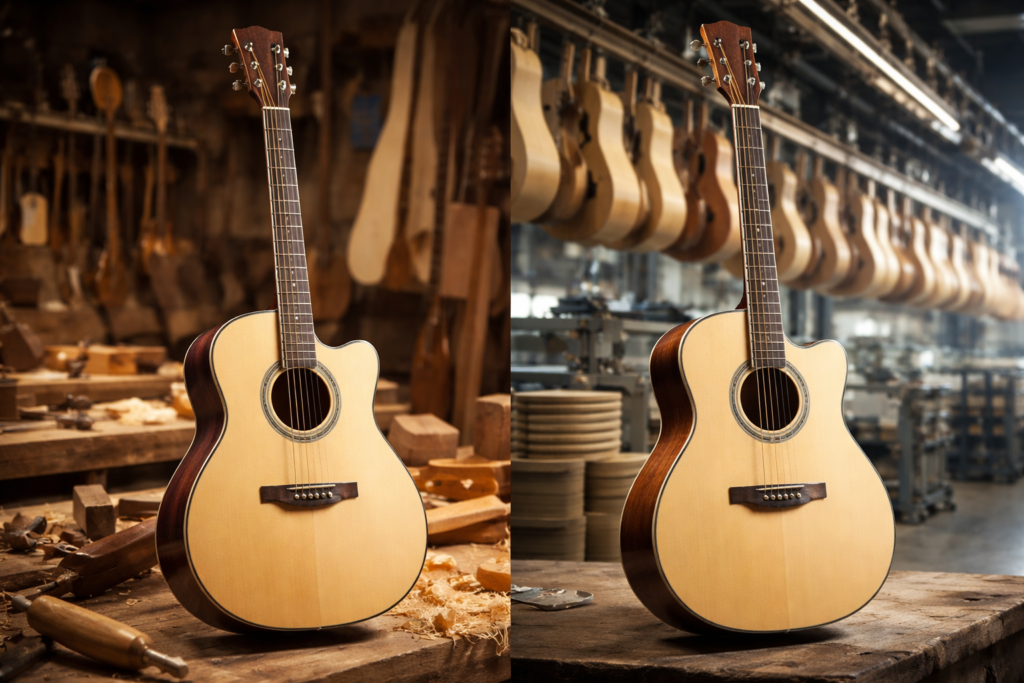
By understanding traditional Filipino luthiery, recognizing the differences between handcrafted and factory-produced instruments, and learning how to read guitar labels correctly, musicians can better appreciate not just how a guitar looks—but how it feels, sounds, and inspires creativity.
-Mr.Cool
Share This Page: